Crypto Mixer vs Privacy Coin: Which Is Better?
Mixers and privacy coins approach the same problem differently. A practical comparison of trust, cost and risk for anyone deciding which to use.
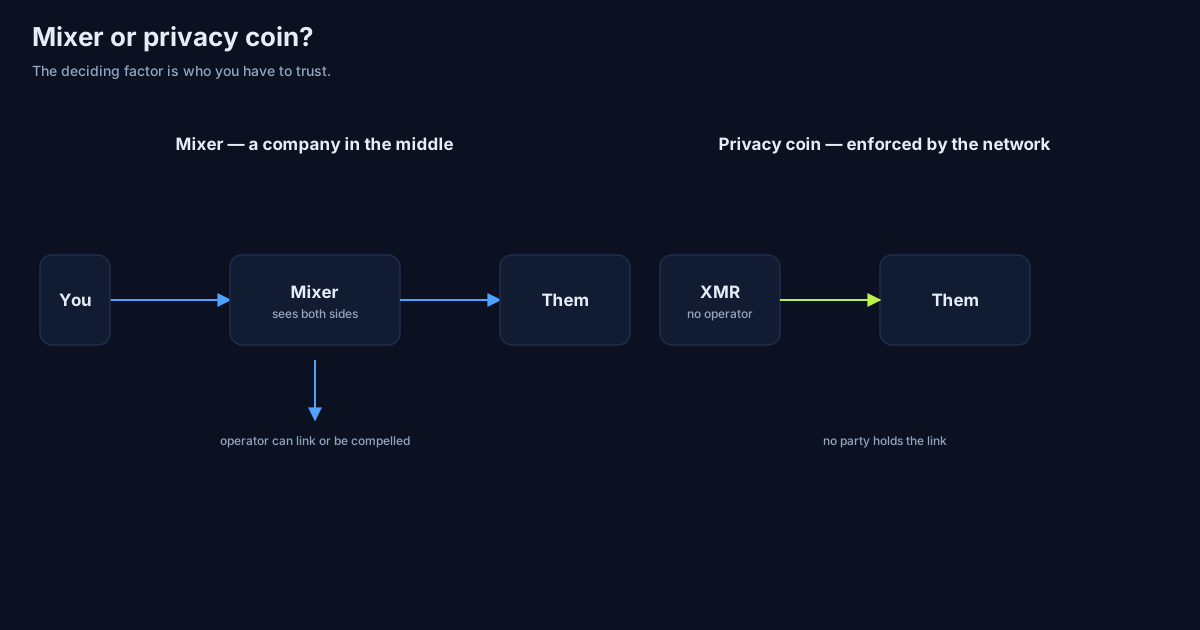
Both approaches exist to break the link between sender and receiver. They differ fundamentally in where the privacy comes from, and that difference should drive your choice.
The core difference
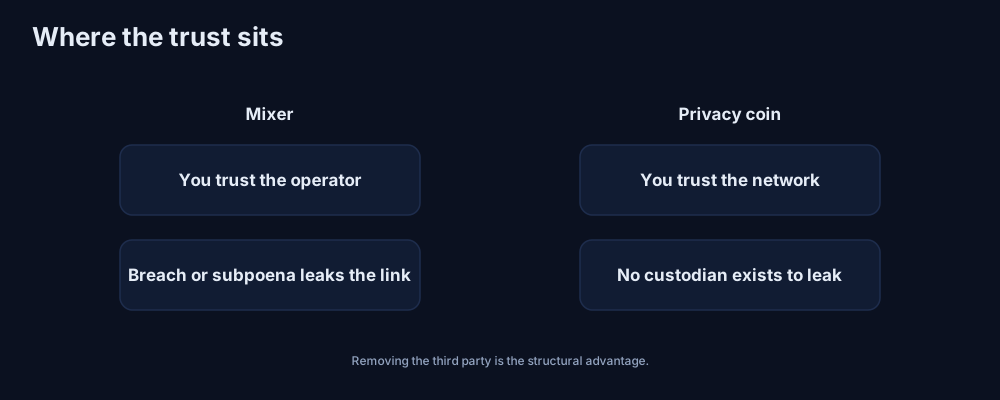
A mixer is a service. You send coins to it, and it returns coins from a pool, relying on its operator to behave honestly. A privacy coin is a protocol. The property is enforced by every participant in the network, with no company in the middle and nobody who can be compelled to hand over records.
Mixers
- Works with any coin, including Bitcoin and Ethereum
- Centralised, and therefore dependent on the operator remaining honest and solvent
- The operator sees incoming and outgoing addresses, and can link them
- Record-keeping is the attack surface: a leaked log, or a legal request, undoes the privacy
- Fees are typically a percentage of the amount
A mixer is trusted with data whose whole purpose is to be unlinkable. That is a difficult position for any operator to hold honestly, and for a long time, poorly run services have demonstrated the point.
Privacy coins
- No operator, so no single point of failure or betrayal
- Privacy applies to every transaction on the network, not just those routed through a service
- Costs a conversion across networks, plus both chains' fees
- Slightly slower than a direct transfer, because conversion takes time
- Some exchanges and services decline to support them, which is a genuine practical drawback
Side by side
| Mixer | Privacy coin | |
|---|---|---|
| Requires trusting a third party | Yes | No |
| Works with any coin | Yes | No, only the routes offered |
| Privacy is automatic | No | Yes |
| Speed | Fast | Slower |
| Cost | Percentage fee | Two chain fees |
| Weakest link | The operator | The funding source |
Which should you pick?
If you need to move a coin that has no private equivalent, a mixer may be your only option, and the trust trade-off is worth understanding rather than ignoring. If the asset can be routed privately, doing so removes an entire category of risk: there is simply no party who knows the link.
In practice, routing through a privacy coin is the stronger choice wherever it is available, and the deciding factor for many people is not privacy itself but removing a trusted third party from the path.
These guides are written to be accurate rather than promotional. If something here is out of date or wrong, it should be corrected, not defended.
Create a wallet