Is Monero Truly Untraceable? An Honest Answer
Monero is private by design, not anonymous by magic. What the blockchain hides, what it does not, and how researchers analyse it anyway.
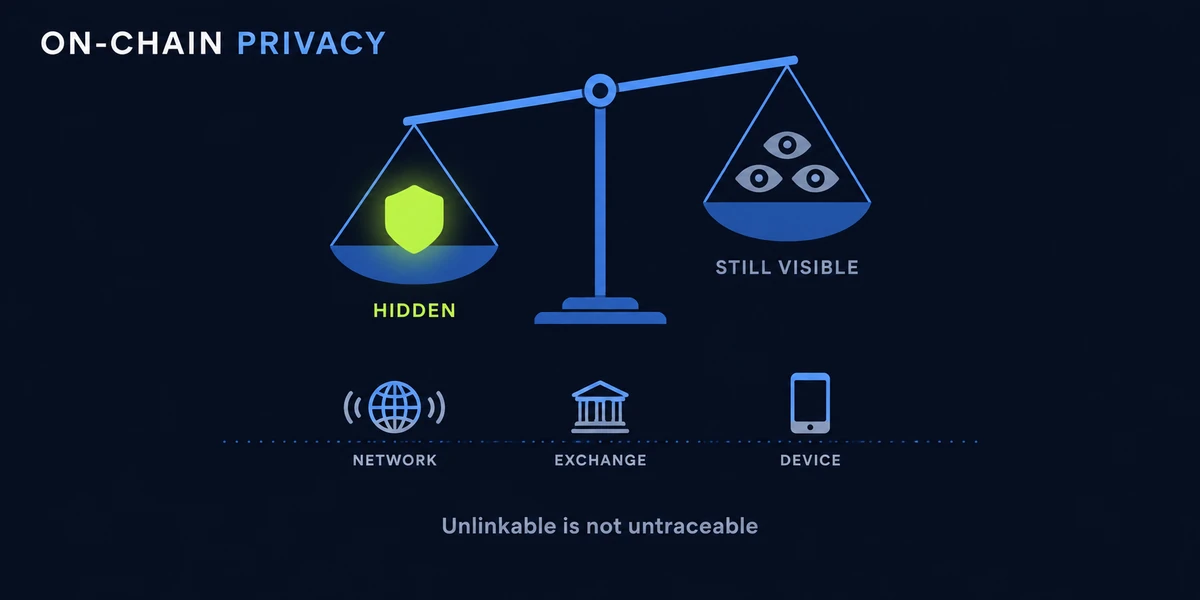
"Untraceable" is the word vendors use. Privacy advocates use "unlinkable", which is less catchy and considerably more accurate. The difference between those two words is the whole answer.
What Monero hides
- The sender's address, from the recipient's
- The recipient's address, from the sender's
- The amount transferred
- Whether an account has ever been used before
These are properties of the protocol itself, applied to every transaction by default. They are not optional features, and they do not depend on mixing after the fact.
What it does not hide
Being hidden on-chain is not the same as being unidentified. Several categories of information survive regardless of the ledger design.
- Network-level observation: that a connection to the Monero network happened, and roughly when
- A KYC exchange record, created before the funds ever moved privately
- Operational habit: consistent amounts, consistent timing, a regular counterparty
- Your own device, and any malware or logging software on it
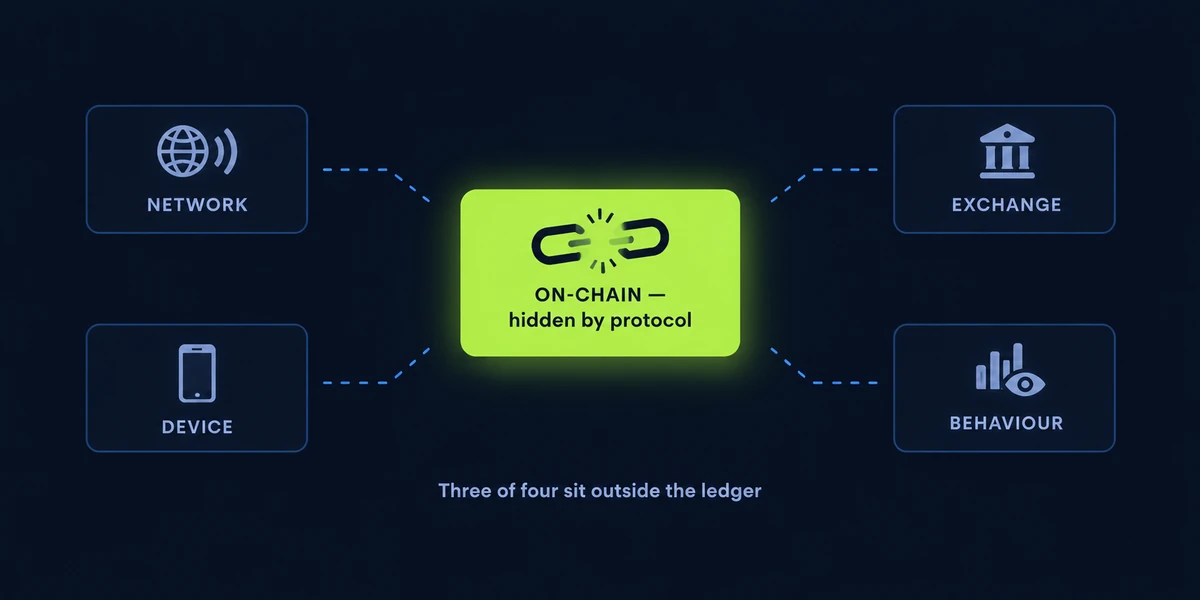
Monero makes analysis of the public ledger impractical. It does not make you anonymous to your internet provider, to an exchange you used, or to anyone already holding information about you.
How researchers still learn things
If the ledger hides the relationship, analysis shifts to the edges. That is not a flaw to be patched; it is the natural consequence of privacy by design.
- On the funding side: if you buy through a KYC exchange, the withdrawal is recorded there
- On the network side: timing correlation and observable volume remain, and are studied actively
- On the behaviour side: statistics about when and how much someone transacts are informative on their own
- On the device side: malware, or a wallet that phones home, defeats everything above
Choosing your funding source
If the source of the funds is your real risk, it is the only part genuinely worth your attention. Acquiring coins without a paper trail is a different, and considerably more involved, problem than sending them privately.
The practical guidance is unglamorous: use sources you have decided you are comfortable having on record, understand what that source already knows, and do not treat a private send as erasing an earlier trace.
Bottom line
Monero is unlinkable, and that is a genuinely strong property. It is not untraceable in the absolute sense that marketing copy implies. The honest framing is that it moves the difficulty of surveillance from trivial to substantial, and that the remaining risk usually lives outside the blockchain entirely.
These guides are written to be accurate rather than promotional. If something here is out of date or wrong, it should be corrected, not defended.
Create a wallet